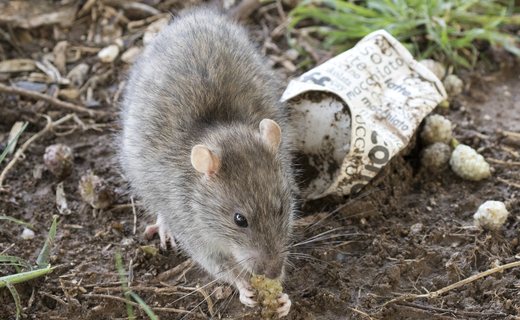
They burrow rather than climb, they need only a few ounces of food a day, and a commercial block supplies it.
The rat you have is a digger
The Norway rat is heavy-bodied, blunt-nosed, and a burrower. It is not the climber people picture. It digs against foundations, under stoops and sheds, beside dumpster pads, and along the fence lines of alleys, and it lives in a system of tunnels with multiple entrances.
Look for the burrows: smooth, greasy holes about two to three inches across, usually with a fan of loose soil outside, often tucked against a wall or under something. Fresh burrows have no cobwebs and no debris in the opening.
Why the commercial corridor is the engine
A rat needs roughly an ounce of food and an ounce of water a day. A block of restaurants, groceries, and takeout places produces that a thousand times over, every night, in bags left on the sidewalk and in dumpsters that do not close. That block sustains a colony, and the colony expands outward into the residential streets behind it.
This is why a homeowner three streets from any commercial activity still gets rats. The population is not generated in their yard. It arrives from the corridor, and their yard just happens to have a shed with a soft spot underneath it.
How they get into the building
A rat passes through a gap about the size of a quarter. In a century-old building the candidates are everywhere: deteriorated mortar in a stone or block foundation, the joint where the sill plate meets the wall, gaps around water and gas lines and electrical conduit, abandoned pipe chases, coal chutes and sidewalk vaults nobody has looked at in fifty years, basement doors and windows that no longer seal.
Then there is the sewer. A broken lateral puts rats directly under your floor, and no amount of exterior work reaches them. If the pattern of activity does not make sense, that is a line worth having scoped.
Why poison is the wrong first move here
In dense housing a poisoned rat dies in a wall or under a floor, and the odor lasts for weeks in a building where nobody can open that wall. Bait in a shared basement raises real questions about children and pets. And poison does nothing about the next rat, because the burrow, the food, and the hole in the foundation are all still there.
Trapping on the runways rats actually use, then exclusion, is the sequence. Mortar and mesh at the foundation, sealed penetrations, corrected door sweeps, screened vents, treated burrows outside.
The block-level part
Secure the trash. Clear the alley clutter that gives them cover. Fix the drainage. Fill the burrows and watch whether they reopen, which tells you whether the colony is still active. If the building next door does nothing, expect to keep working.
For landlords and businesses along the corridors this is a standing program rather than a one-time call. An experienced local exterminator will treat the alley and the dumpster pad as part of the property, because the rats already do.
Call and connect with an experienced local exterminator.